
Agri-Marketers are Embracing Change Without Losing Connection
Key Findings from NAMA's 2026's Industry Research
In April 2026, NAMA partnered with Meyocks to conduct research during the NAMA Agri-Marketing Conference in St. Louis to better understand the current state of agri-marketing and how members are navigating an industry evolving economically, culturally, and technologically. The research combined on-site qualitative interviews with a mobile-friendly quantitative survey completed by 120 conference attendees representing a broad mix of roles, experience levels, and organization types.
The findings reveal an industry balancing rapid change with optimism — one where professionals are eager to embrace new technologies and ideas, but still deeply value human connection, shared learning, and community.
Networking continues to drive the value of NAMA membership.
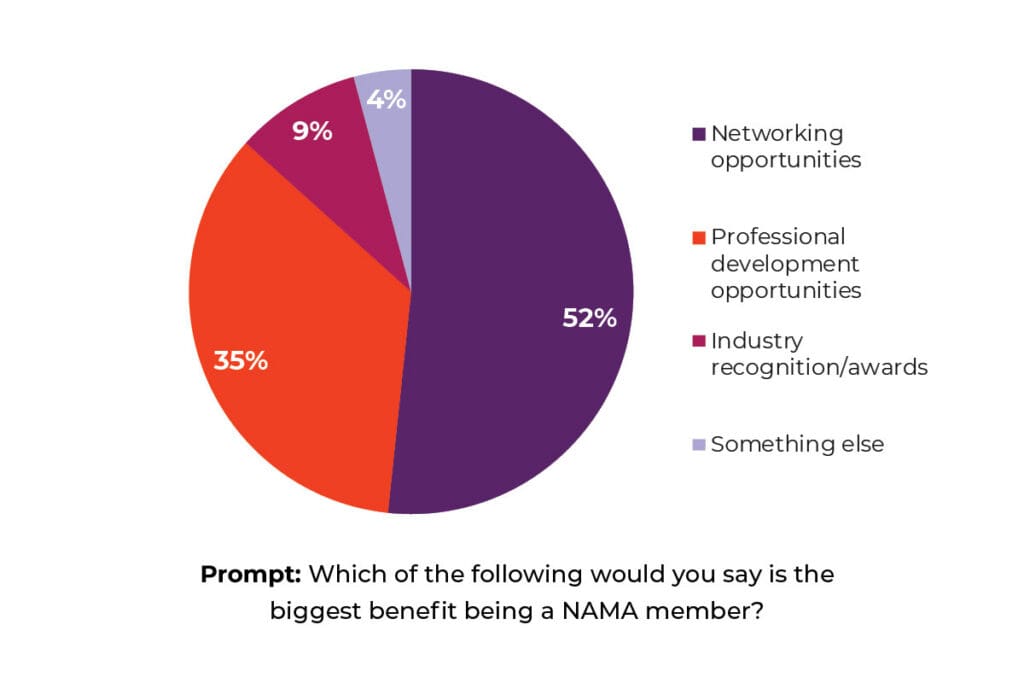
While professional development opportunities remain important (35%), NAMA members say that networking is their primary benefit of their membership, with 52% of survey responses. Additionally, interview participants consistently referenced “face-to-face time,” “connecting,” and “exposure” to other members as their main motivations for attending the conference.
The research also highlighted strong participation from newer members and first-time attendees, reinforcing the continued relevance and growth potential of the NAMA community.
Audience Insights and AI are top learning priorities.
When asked what skills and knowledge areas they most want to develop, the top three responses include customer insights and audience segmentation (41%), AI in marketing (41%), and brand strategy and positioning (38%).
Members prefer to gain these additional skillsets via a mix of in-person conferences (37%), live webinars (35%), and case studies/real world examples (34%). More specifically, members who are most interested in learning about customer insights would prefer to attend in-person conferences (43%), while those who selected AI in marketing claimed they’d like to see live webinars (47%). Members most interested in campaign measurement selected the case studies format (43%).
AI adoption is growing, but uncertainty remains.
The research shows that most NAMA members are already incorporating AI into their workflows in some capacity, though only 10% claimed it is heavily integrated into their work. Nearly half of members (47%) are using AI occasionally, with just under a third (30%) saying they use it regularly.
The most common uses of AI include idea generation/brainstorming (79%), workflow efficiency (67%), and research (50%). There are differences in levels of AI adoption and use cases. For instance, those members whose AI usage is heavily integrated into their workflow are far more likely to use it for data analysis/insights (83%) than those who use AI regularly (36%) or only occasionally (18%). AI use for idea generation is high across all levels of AI usage, as is workflow efficiency.
Despite uncertainty, the industry remains optimistic.
One of the strongest themes to emerge from both the survey and interviews was resilience. Even amid economic pressures, shifting technologies, and changing expectations, respondents consistently expressed optimism about the future of agriculture and agri-marketing.
Participants spoke about “a spirit of renewal,” opportunities for creativity, and excitement around the next generation entering both agriculture and marketing. The findings suggest an industry that is not resisting change, but actively looking for ways to evolve and adapt together.

Rise of the Intentional Internet: What it Means for Marketers in 2026
Meyocks Launches Customizable AI Tool to Simulate Ag Producer Feedback During Planning